
Using a Closely Held LLC to Gift Ownership Interests to Children: A Strategic Exit and Estate Planning Guide


Recently, we explored using a trust versus an LLC as an estate planning tool, followed by a discussion of family trusts owning LLC interests and the complications that can arise when transfer restrictions apply. Building on those topics, this post focuses on how a closely held limited liability company (LLC) can be used to gift ownership interests to children in a structured, deliberate, and tax‑efficient manner—while preserving control and supporting a broader exit or succession plan.
For many business owners, exit planning and estate planning are not independent exercises.
Decisions about ownership, governance, and succession affect both the future of the business and the family legacy attached to it. When structured carefully, an LLC can serve as a flexible vehicle for transferring wealth incrementally, preparing the next generation for ownership, and minimizing disruption to operations.
Why LLCs Are Well‑Suited for Gifting Strategies
A closely held LLC offers significant advantages when gifting ownership interests because it allows economic rights and control rights to be separated. Through a thoughtfully drafted Operating Agreement, parents can retain management authority or voting control while gifting nonvoting economic interests to children. This structure permits the transfer of value and future appreciation out of the parents’ taxable estates without surrendering day‑to‑day or strategic control.
LLCs also offer valuation flexibility. Minority, nonvoting interests in a closely held entity may qualify for valuation discounts for lack of control and lack of marketability when supported by a qualified appraisal. These discounts can make annual exclusion gifts more efficient and allow larger transfers to be completed using lifetime exemption amounts. Proper valuation also positions the LLC more favorably if an outside investment or redemption opportunity arises, as sophisticated buyers expect disciplined valuation practices.
From an administrative standpoint, LLC interests can be transferred incrementally through membership units rather than by dividing underlying business assets. This simplifies recordkeeping, supports phased gifting, and aligns ownership transfers with a gradual exit or management transition. In a manager‑managed LLC, continuity is preserved as the founder remains at the helm while mentoring successors.
Common Gifting Structures and Techniques
There is no single approach that fits every family or business, but successful gifting strategies typically balance tax efficiency, governance, and family dynamics.
One common technique is the creation of separate classes of voting and nonvoting units. Parents retain voting units that control major decisions, while children receive nonvoting units that carry rights to distributions and appreciation. This approach allows wealth transfer without prematurely relinquishing authority.
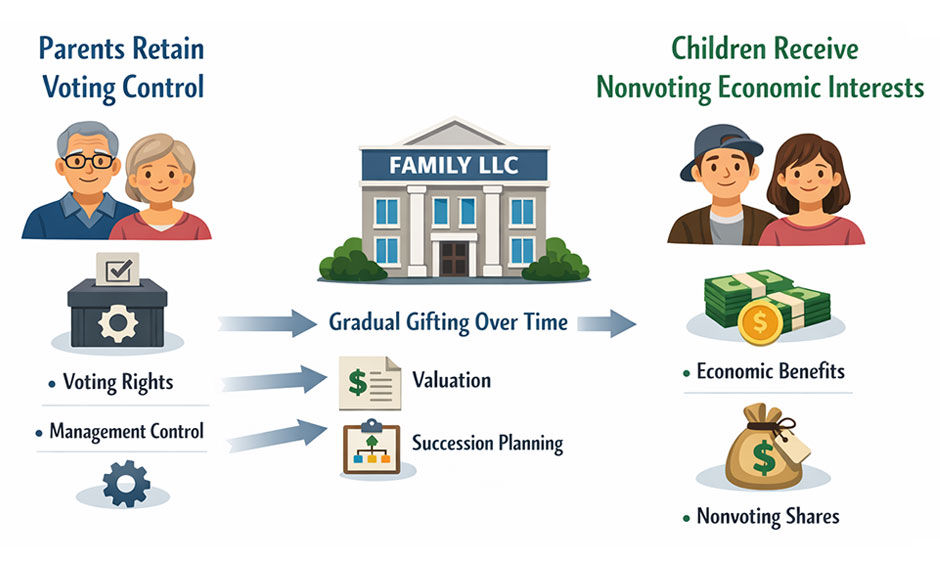
Phased gifting is another core strategy. Rather than transferring a substantial interest at once, owners often make annual gifts over time, using the annual exclusion while monitoring valuations and business performance. Larger gifts using lifetime exemptions may be appropriate when significant growth is anticipated, allowing future appreciation to accrue outside the taxable estate.
In many cases, interests are gifted not directly to children but to irrevocable trusts for their benefit.
Trusts can provide creditor protection, address spendthrift concerns, and help ensure that ownership remains aligned with family objectives across generations. Dynasty trusts, are frequently paired with LLC gifting strategies, depending on tax and planning goals.
Some owners also incorporate incentive‑based ownership, such as profits interests or performance‑based units. These interests can be tied to operational or financial benchmarks—revenue growth, EBITDA targets, or leadership milestones—to encourage engagement and accountability without exposing the business to unnecessary risk.
Liquidity planning is an essential companion to any gifting strategy. Buy‑sell provisions, redemption rights, and distribution policies should be coordinated so that children understand how and when value may be realized, without creating cash‑flow stress for the business or conflict among siblings.
Legal and Structural Considerations
The success of an LLC gifting strategy depends heavily on the strength of the entity’s legal framework, particularly the Operating Agreement. The agreement should clearly define voting and nonvoting rights, manager authority, fiduciary duties, and indemnification provisions. Transfer restrictions—such as rights of first refusal, consent requirements, or prohibitions on transfers outside the family or approved trusts—are critical to maintaining stability and preventing unintended third‑party ownership.
Valuation support is equally important. Each meaningful gift should be supported by an independent, qualified appraisal, and gift tax returns should be timely filed with adequate disclosure to start the statute of limitations. Poor documentation or inconsistent valuations can undermine the intended tax benefits.
Tax coordination cannot be overlooked. Grantor trust status, income tax treatment, basis planning, and state tax considerations all affect the long‑term effectiveness of the strategy. If the LLC is taxed as an S corporation, additional care is required to ensure that all owners and trusts are eligible shareholders.
Finally, governance and risk management deserve attention. If children serve as managers or have expanded authority, the Operating Agreement should address decision‑making procedures, insurance coverage, and dispute resolution mechanisms. Existing shareholder agreements or buy‑sell arrangements must be harmonized with the LLC structure to avoid conflicting obligations.
Implementing the Strategy
Begin by clarifying objectives, exit timeline, desired level of retained control, and intended ownership outcomes for each child. Revise the Operating Agreement as needed to create appropriate equity classes, embed transfer restrictions, and align buy‑sell mechanics.
Equally important is preparing the next generation through governance meetings, financial transparency, and mentorship. Ownership without education often leads to conflict; ownership with preparation supports continuity.
Conclusion
When used thoughtfully, a closely held LLC can be the backbone of an integrated exit and estate planning strategy. It allows business owners to shift value, preserve control, and prepare successors without destabilizing the enterprise. With careful design and ongoing review, the LLC becomes more than a legal entity—it becomes the vehicle through which business continuity, family legacy, and tax efficiency align.


